

A governance diagnostic built for tool-using, memory-bearing, delegating AI systems — and for the financial institutions deploying them.
Classical AI governance frameworks were written for models. Agentic AI introduces a different control problem: permissions, context pipelines,
tool-use boundaries, session persistence, delegation chains, external dependencies, and observability all become part of the governance surface.
The Agentic AI Governance Review helps banks, asset managers, funds, fintechs, RIAs, and market-infrastructure firms identify where governance is encoded in infrastructure — and where it still exists only in policy language.
of enterprise AI users bring unauthorized tools to work — creating a shadow AI governance problem before formal programs are mature.
diagnostic dimensions score the deployment across architecture, standards alignment, financial-services risk, and agentic-specific failure modes.
page production Findings Reports translate the diagnostic into regulator-ready analysis, evidence mapping, and a 90-day remediation roadmap.
weeks from kickoff to executive readout for the fixed-scope AGR engagement, designed to move quickly without becoming vague.
Shadow AI figure drawn from NextFi Advisors, Lessons for Enterprise AI Deployments. Deliverable depth, dimensions, and timeline reflect the current AGR diagnostic and sample Findings Report structure.
Most institutions still discuss AI governance at the policy layer. Agentic deployments require a more operational view: where permissions are enforced, how long-horizon context is managed, how subagents delegate work, where tools connect to external systems, and what is actually logged when the system acts.
 Open full infographic
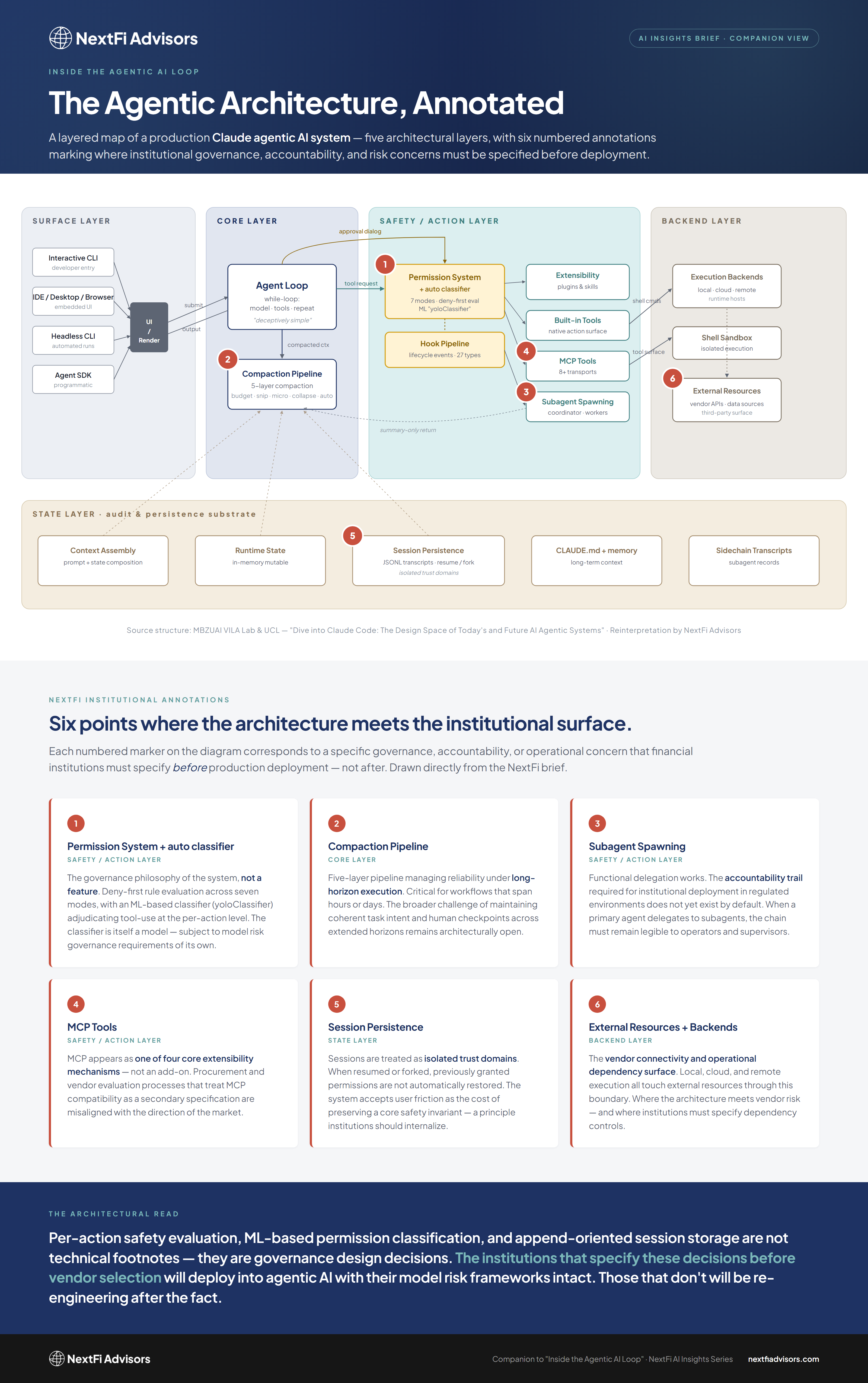
NextFi’s annotated architecture maps a production Claude-based agentic system across five layers, then marks the six institutional hotspots where governance, accountability, and operational risk must be specified before deployment — not after the first control incident.
All six governance hotspots have been overlaid onto Meet Herman — an interactive walkthrough of the Hermes agentic architecture — so you can see exactly where each surface appears in a working production system.
Explore Meet Herman →The architecture determines what governance is even possible. The operating model determines whether it actually happens.
In production agentic systems, output quality and control quality increasingly depend on context design, session lifecycle, handoff discipline, and pre-execution challenge controls — not only on model choice or written standards.
When institutional context is rebuilt from scratch every session, outputs stay generic and audit trails become shallow. Governed context infrastructure changes both quality and defensibility.
As context accumulates, instructions degrade, coherence slips, and outputs become less stable. High-stakes workflows need bounded sessions, controlled handoffs, and resumable evidence.
Socratic prompting and pre-execution challenge are not stylistic niceties. They are workflow controls that make assumptions, ambiguities, and scope limits explicit before the agent takes consequential steps.
Agentic AI governance is not a single discipline. It is the intersection of infrastructure design, regulatory standards, financial-services risk, and a class of failure modes that classical model risk frameworks do not see cleanly.
Answer 24 questions. Get an instant tier score, per-lens breakdown, and your top three gaps. No email required to see your preliminary results.
Less than 10 minutes. No email required to view preliminary results.
Take the Diagnostic →Designed so executive, control, and engineering stakeholders can read the same deliverable for different decisions.
View the Sample ReportProspective buyers rarely evaluate agentic AI alone. They are already managing questions from boards, risk and compliance teams, engineering leaders, and supervisors. The AGR is designed to translate one deployment into a common fact pattern each of those audiences can work with.
What upside does this create, what can go wrong, what dependencies does it introduce, and who is accountable when the system takes action?
Which controls live in policy, which are implemented in infrastructure, what is logged, and how would this hold up under internal review or examination?
Where do permissions, memory, session design, tool boundaries, and delegation controls need to be implemented so the deployment remains operable as it grows?
How do oversight, outsourcing, recordkeeping, model risk, and operational dependency map to the way the system actually behaves in production?
The AGR is not a generic scorecard. The production deliverable is a findings report written in a tone that classical risk practitioners, security teams, technology leads, and senior management can all use.
Prompt-level instructions are not enforcement. If a system can invoke tools without an independent permission layer, the institution has a written policy but not a hard control.
When session persistence is enabled without explicit retention policy, redaction discipline, or audit logging, memory becomes an unmanaged control surface rather than a convenience feature.
Where sanctioned platforms and technical enforcement are absent, acceptable-use policies alone do not prevent material AI usage from moving into unsupervised channels.
The free diagnostic surfaces where you stand. The Agentic AI Governance Review is the fixed-scope, regulator-ready engagement that translates those signals into a structured findings report and an executable roadmap.
Out of scope (separate engagements): implementation, tooling selection, ongoing monitoring, regulatory representation. Kept narrow by design.
Run the diagnostic first, or skip ahead and schedule a 20-minute scoping call.